
Short answer: Arabic speech recognition is now very good at formal Arabic and still weak at everyday dialect. On the benchmark table published with Jais Speech in October 2026, the best systems get about 1 word in 10 wrong on Arabic news broadcasts, but nearly 1 in 2 on casual dialect conversation. So if a vendor says "we support Khaleeji", test it on your own calls before you sign.
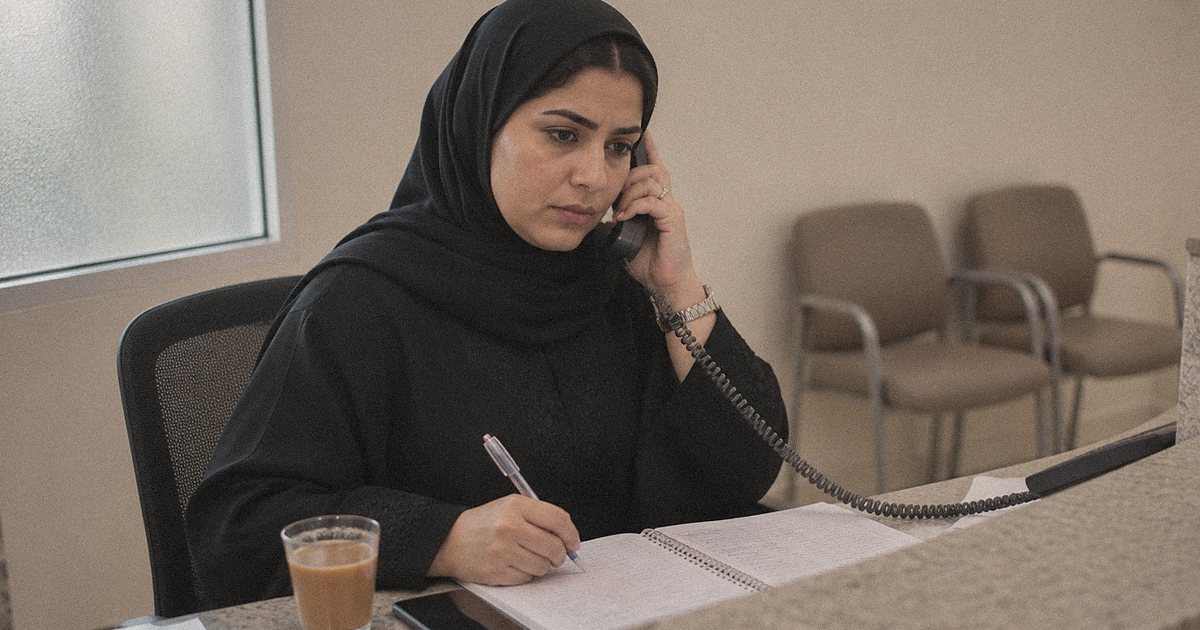
You know this moment. A customer calls at 9:40 pm. She speaks Emirati Arabic, drops the English word "booking" halfway through a sentence, gives her area as "Khalifa A" and reads out a mobile number at speed. A good receptionist gets all of that without blinking. The question for anyone putting an AI voice agent on their phone line is simple: does the machine?
October gave us a reason to ask again. Within about ten days, two Abu Dhabi teams released Arabic speech models aimed at exactly this problem: TII's Falcon-ASR and MBZUAI's Jais Speech. Both came with confident headlines. Both also came with numbers, and the numbers are more useful.
I run VYZR AI in Dubai, and Khaleeji Arabic is the thing our customers ask about first, before price and before integrations. So we went through the public benchmark tables line by line. Here is what we found, what it means for your phone line, and a test you can run this week.
What did the UAE actually launch in October 2026?
Falcon-ASR (TII, 7 October 2026). A compact 1.6-billion-parameter speech-to-text model covering Emirati Arabic, Modern Standard Arabic, English, French, Spanish and Portuguese. It arrived with Falcon-Emirati, a 7-billion-parameter language model built for Emirati idioms. TII says Falcon-ASR beat a 30-billion-parameter model on an Emirati speech benchmark. When we checked on 9 November, TII's Hugging Face page had a public demo for clips of up to 60 seconds, but no downloadable model.
Jais 3 and Jais Speech (MBZUAI's Institute of Foundation Models with Inception42, mid-October 2026). Six language models from 900 million to 375 billion parameters, plus Jais Speech (listed on Hugging Face as Jais-ASR), which transcribes formal Arabic and dialects from 19 Arab countries. It can tell which dialect is being spoken, and when a caller switches into English or French it keeps those words in their original script. It is open under the Apache 2.0 licence, so any company can run it on its own servers and check the claims. An open model with a published results table is something you can verify. A press release is not.
Sources: Gulf Business (7 October 2026), Gulf News (15 October 2026), Jais-ASR model card on Hugging Face (checked 9 November 2026).
How accurate is Arabic speech recognition now?
Speech accuracy is usually reported as word error rate (WER): out of every 100 words spoken, how many the system got wrong, left out or added. Lower is better. A 10% WER means roughly one wrong word in ten.
The Jais Speech team scored its model on the test sets of the Open Universal Arabic ASR Leaderboard, a public benchmark project, and compared it with other open models and with two commercial services, Speechmatics and ElevenLabs. We pulled out the rows that matter most for a business phone line.
| Test set (what the audio is) | Jais Speech | Audar-ASR-V1-Turbo | Speechmatics Melia 1 | ElevenLabs Scribe v2 | Qwen3-Omni-30B |
|---|---|---|---|---|---|
| MGB-2: Arabic broadcast news, mostly formal Arabic | 9.59% | 11.08% | 12.61% | 10.30% | 13.09% |
| Common Voice 18: people reading formal Arabic aloud | 8.56% | 8.09% | 5.19% | 8.71% | 11.46% |
| MASC noisy: lectures with background noise | 25.44% | 27.19% | 25.89% | 27.15% | 30.85% |
| SADA: Saudi dialect broadcast | 30.85% | 28.92% | 34.74% | 33.96% | 44.82% |
| Casablanca: casual conversation in 8 dialects | 46.56% | 47.02% | 46.41% | 50.20% | 62.55% |
| Average of six test sets | 22.85% | 23.17% | 23.51% | 24.54% | 30.71% |
Source: Jais-ASR model card, Institute of Foundation Models, Hugging Face (checked 9 November 2026). Word error rate, lower is better. Speechmatics and ElevenLabs scores were measured by the Jais team; the other scores come from the leaderboard. Table trimmed by VYZR to five of the nine systems listed.
Two things jump out. The top four systems sit within about two points of each other on the average, so nobody has run away with this. And the "best" model depends on the audio: Jais Speech wins on broadcast news, Speechmatics on clean read speech and dialect conversation, Audar on Saudi dialect. If someone tells you one engine is simply "the most accurate for Arabic", ask: on which audio?
Then look at how far every system falls between the first row and the fifth. That fall is what matters for your phone line.
Why does Khaleeji still trip up the machines?
VYZR analysis of the table above: Jais Speech makes almost five times as many word errors on dialect conversation (46.56%) as on broadcast news (9.59%). ElevenLabs shows the same jump, from 10.30% to 50.20%. Speechmatics goes from 12.61% to 46.41%. In plain terms, the best Arabic speech systems available today get close to half the words wrong when people talk the way they actually talk to each other.
This is not one vendor's problem. The first version of the same leaderboard (Yingzhi Wang and colleagues, December 2024) found every model did best on formal Arabic and dropped sharply on dialects such as Egyptian and Khaliji: the top model scored 19.23% on formal Arabic and 40.97% on Egyptian. The authors blame the training data. In MGB-2, a widely used Arabic speech dataset, more than 70% of samples are formal Arabic.
The Jais team told The National the same about the Gulf: there is less open Gulf dialect data, open models tend to fall back on formal Arabic, so the team used extra data synthesis and filtering. Haonan Li, a senior research scientist at the institute, told Khaleej Times: "Dialects remain the hardest frontier for every model."
What about Emirati Arabic on its own? The Casablanca dataset, released in October 2024 by Bashar Talafha and a large team of co-authors, is the biggest public set of transcribed Arabic dialect speech we could find, at almost 48 hours across eight dialects. About six hours of it is Emirati, taken from TV series. Before any tuning, OpenAI's Whisper large-v3 got 62.31% of Emirati words wrong. With text clean-up applied, that fell to 52.88%.
| Dialect (Casablanca test set) | Whisper large-v3, raw | Whisper large-v3, after text clean-up |
|---|---|---|
| Jordanian | 48.44% | 39.68% |
| Egyptian | 59.11% | 48.95% |
| Emirati | 62.31% | 52.88% |
| Yemeni | 69.94% | 59.45% |
| Moroccan | 87.20% | 83.05% |
Source: Talafha et al., "Casablanca: Data and Models for Multidialectal Arabic Speech Recognition", arXiv 2410.04527 (October 2024), Table 3, zero-shot word error rate. Five of the eight dialects shown.
Whisper is an older, general-purpose model, so treat this as a starting point, not today's best. Emirati sits mid-pack: harder than Jordanian or Egyptian, easier than Yemeni or Moroccan.
Word error rate is harsh on dialect. Dialect has no fixed spelling, so a word spelled slightly differently counts as fully wrong. Character error rate is kinder: on the same Casablanca set, Jais Speech gets 18.02% of characters wrong against 46.56% of words. Many "wrong" words are nearly right, and the AI reading the transcript can often still work out what the caller meant.
Does a 46% error rate mean an AI receptionist can't handle Gulf callers?
No. Both the hype and the doom miss the point here. A benchmark measures every word. A phone call succeeds or fails on a handful of them. When someone rings a clinic in Al Barsha to move an appointment, the call lives or dies on four things: their name, their number, the day and time, and what they want done. If the system mishears a filler word or spells "شلونك" three different ways, nobody cares. If it hears Tuesday as Thursday, everybody does.
Real calls can also be harder than the benchmark. Casablanca comes from TV series with proper sound; a phone line carries thinner, compressed audio, often from a car on Sheikh Zayed Road. And callers ramble, interrupt and switch between Arabic and English mid-sentence, which Jais Speech says it handles but public test sets barely measure.
When we started VYZR in December 2024, Khaleeji was the first thing we tested, and it is still what we test first with every new client. We have handled about 15,000 calls so far. We don't publish a single accuracy number of our own, and I would be wary of anyone who gives you one without saying what audio it was measured on.
How do you test a vendor's "Khaleeji support" before you sign?
Here is the test I would run in your seat. It takes days, not months.
- Use your own calls. Collect 30 to 50 real recordings from your line, with consent and within your privacy rules. Mix ages, Emirati and other Gulf callers, quiet rooms and cars. A vendor's demo proves nothing about your callers.
- Score the details, not the whole transcript. For each call, write down the five facts a human would need: name, phone number, date and time, location, and the request. Then count how many the system got exactly right.
- Include the hard bits on purpose. Phone numbers read in Arabic. Area names like Mirdif, Khalifa City or Al Khawaneej. Amounts in dirhams. An English word in the middle of an Arabic sentence. Someone who gives their name, then corrects it.
- Test on a real phone line. Ring the agent from a mobile on e& and on du, not from a laptop microphone. Phone audio is where many good demos fall apart.
- Ask four questions. Which speech model do you use, and can we switch it? Where is the audio processed and stored? What happens when the agent is not sure it heard correctly? How fast does it hand over to a human?
| What to score | Why it matters | A fair pass mark to aim for |
|---|---|---|
| Caller's phone number | A wrong digit means no follow-up | Read back and confirmed on every call |
| Day and time | Easy to mishear, costly to get wrong | Repeated back before booking |
| Location or area name | Local names trip up general models | Correct, or the agent asks again |
| Arabic to English switch | How many Gulf callers really talk | English term kept as said |
| Uncertain moments | Guessing is worse than asking | Agent asks, or hands over to a person |
VYZR test checklist. The pass marks are behaviours to look for, not published benchmarks.
Notice the last column. Nobody has a perfect dialect transcript, so the goal is an agent that confirms what matters and asks again when unsure, like a good receptionist does without thinking.
Should Gulf businesses switch to Jais or Falcon now?
Not on the strength of a launch week. But these releases are good news. They are built here, with Gulf dialects as a stated goal. Jais Speech is open, so it can run on servers inside the UAE, which matters to clinics, banks and anyone with strict data rules. And on the leaderboard average, an open model built in Abu Dhabi now sits level with the big commercial services.
The honest caveat is that almost every number in this post comes from the teams that built the models. The Jais team says it is releasing its 24 Arabic benchmarks publicly, and that is the right move. Until independent testers run the same sets on Gulf phone audio, treat every leaderboard as a shortlist, not a verdict.
So pick a voice agent provider that can swap speech engines as better ones arrive. The engine that wins today may not win in six months.
Frequently asked questions
What is the most accurate Arabic speech recognition model in 2026?
Does AI understand Emirati and Khaleeji Arabic?
What is word error rate (WER)?
Can an AI voice agent handle callers who mix Arabic and English?
Hear how an agent handles your callers
Send us a few of your typical calls and we will show you, detail by detail, what an Arabic voice agent gets right and where it hands over to your team. Our Khaleeji testing, e& and du numbers and UAE data residency are all part of the setup.
See Arabic voice AI →Next: our guide to multilingual AI voice agents in the Gulf, how an AI receptionist handles handovers, the Zain Middle East Properties case study (10,000+ calls with warm and cold transfers), and our pricing.
Sources
- Jais-ASR model card, Institute of Foundation Models, Hugging Face (evaluation tables, licence; checked 9 November 2026)
- Gulf News: UAE launches Jais 3, Arabic-native AI for speech, writing and agents (15 October 2026)
- The National: Talking your language, UAE unveils AI tool designed to master Arabic dialects (24 October 2026)
- Khaleej Times: Abu Dhabi's new Arabic AI can understand dialects (6 November 2026)
- Gulf Business: Falcon-Emirati, new UAE-built AI model (7 October 2026)
- TII on Hugging Face (Falcon ASR demo; checked 9 November 2026)
- Wang, Alhmoud and Alqurishi: Open Universal Arabic ASR Leaderboard (arXiv, December 2024)
- Talafha et al.: Casablanca, Data and Models for Multidialectal Arabic Speech Recognition (arXiv, October 2024)